Best Digital Design Agencies in 2026

The best digital design agencies depend on what you need to launch or improve: a business website, an application, an interactive experience or a reusable interface system. This guide compares 10 teams through published work and practical delivery questions. Start with the type of experience you are building, then examine the agency’s contribution, implementation responsibilities and handoff. The selection includes website specialists, product design partners and providers of ongoing creative support.

Research checked: 28 October 2026.

Quick Shortlist

Consider Fivecube for business websites connecting UX, visual design and Webflow delivery; Metalab for product interface design; Work & Co for connected commerce; and Hello Monday /DEPT® for reusable website frameworks. Clay and Instrument provide useful examples of explaining complex products through a marketing website.

Compare Digital Design Agencies and Services

A website redesign and a product redesign are different purchases. The table identifies the work used to support each recommendation. These are examples of documented engagements, not announcements of current client relationships.

AgencyRelevant needEvidence reviewedPublished budget
1.FivecubeWebsite UX/UI and Webflow deliveryPointExpressNot publicly disclosed in reviewed material
2.ClayDigital storytelling and website implementationMarqetaNot publicly disclosed in reviewed material
3.Work & CoCommerce across web, app and storesIKEANot publicly disclosed in reviewed material
4.InstrumentProduct education and ecommerce journeysOura websiteNot publicly disclosed in reviewed material
5.MetalabProduct strategy and interface designEarly Slack productNot publicly disclosed in reviewed material
6.ustwoConsumer digital product designThe Body CoachNot publicly disclosed in reviewed material
7.Hello Monday /DEPT®Website frameworks and brand expressionOPPONot publicly disclosed in reviewed material
8.Stink StudiosInteractive editorial websitesSpotify.DesignNot publicly disclosed in reviewed material
9.RamotionTechnology websites and UX/UIPublished web and UX/UI servicesNot publicly disclosed in reviewed material
10.SupersideRecurring creative production and systemsColgate-Palmolive exampleSubscriptions from $15,000/month, annual term; confirm fees

A missing public price does not establish that a provider is more expensive or less expensive than another. Superside’s subscription minimum is not a quotation for a complete website or application.

10 Digital Design Companies Reviewed

1.Fivecube

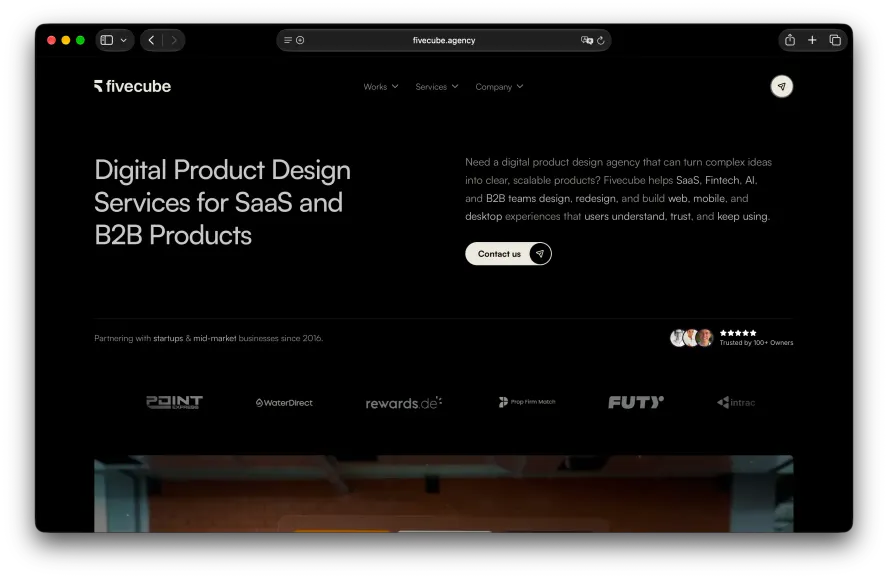
Fivecube homepage in a browser window: black page with the headline “Digital Product Design Services for SaaS and B2B Products”, a Contact us button and a row of client logos.

Fivecube is a relevant starting point when a business needs a website designed and implemented as one defined engagement. Its PointExpress case documents UX research, wireframes, visual direction, responsive design and a Webflow build. The project concerned a logistics company presenting dispatch services and recruiting dispatchers, so the example is a business website rather than a SaaS application.

The published process separates structure approval from visual direction and development preparation. That gives a buyer concrete questions to ask: when is the sitemap approved, which content is supplied by the client, and what happens if the structure changes after interface design begins? A staged proposal should make those dependencies visible.

Compare Fivecube for a website launch or redesign where design-to-build responsibilities matter. Ask for the exact page list, responsive states, CMS collections, form integrations and launch support. If you also need a logged-in product, request separate evidence and scope for its workflows. The website case alone does not establish the depth of an application engagement.

Relevant services:
website UX/UI, responsive design and Webflow implementation.
Budget:
request a scoped proposal.

Visit FivecubeSource: PointExpress

2.Clay

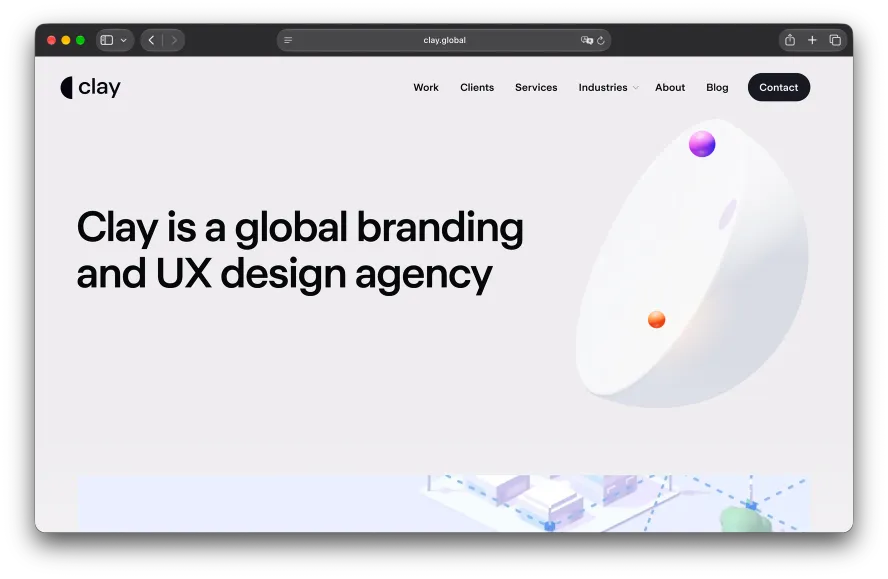
Clay homepage in a browser window: pale lilac page with the clay half-circle logo, a menu of Work, Clients, Services, Industries, About and Blog with a dark Contact button, the headline “Clay is a global branding and UX design agency” and a white 3D half-sphere with a purple and an orange dot.

Clay’s Marqeta project provides an example of digital design connecting a product narrative, interface graphics and a working marketing site. The case lists web design, content, interaction design, 3D design and development. Clay describes explaining the card-issuing platform through visual storytelling and extending the content structure into inner pages.

The published website was responsive and built on WordPress VIP. That detail is useful because a design engagement can end with either approved layouts or an implemented publishing system. Ask where the proposal ends, how components are documented and who can maintain the site after launch.

Consider Clay when a technical offer needs a clear digital presentation with interactive elements. Bring real product information and identify the claims requiring approval. Define which motion explains the offer and which is decorative. A persuasive demonstration should still work on smaller screens and for visitors who do not interact with every element.

Relevant services evidenced here:
website design, content, interaction and development.
Budget:
not publicly disclosed in the reviewed case.

Visit ClaySource: Marqeta

3.Work & Co

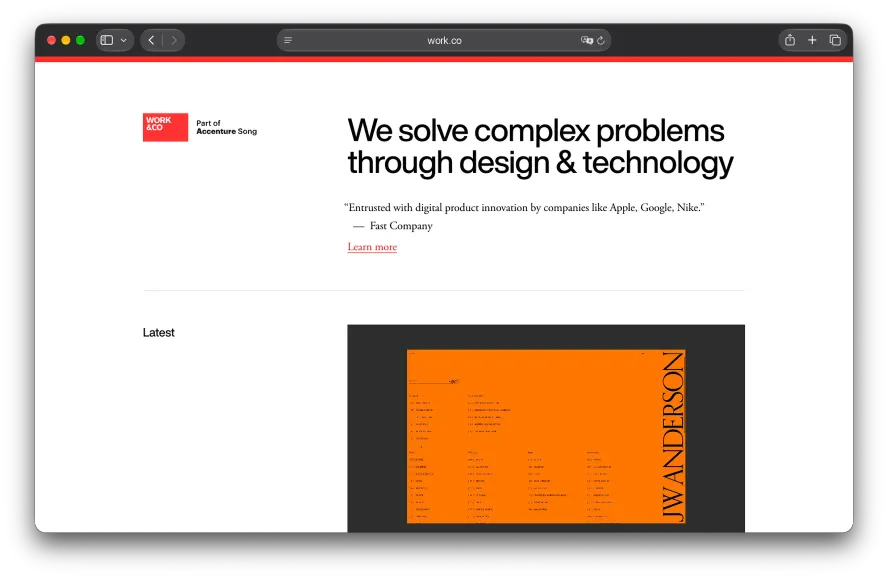
Work & Co homepage in a browser window: white page with the red Work & Co logo and the headline “We solve complex problems through design & technology”, followed by a Latest section with an orange project image.

Work & Co’s IKEA case documents an engagement spanning an ecommerce app, a global website redesign, in-store digital experiences and a design system. It is relevant when the problem crosses channels and the company needs more than a new set of website pages. The published account connects a future customer experience to implementation.

Use the example to examine how a partner handles related journeys. An item discovered on a phone may later be checked in a store or purchased on the web. Ask which customer steps and internal dependencies the agency would study, and how the proposed system would connect with your own commerce platform.

Shortlist Work & Co for a connected commerce brief, subject to confirmation of the proposed team and scope. Specify ownership of integrations, migration, analytics and operational testing. The historical IKEA program is not a promise that another project can reproduce its commercial results, schedule or scale.

Relevant services evidenced here:
digital product design, commerce experiences and design systems.
Budget:
request a proposal covering the required channels.

Visit Work & CoSource: IKEA

4.Instrument

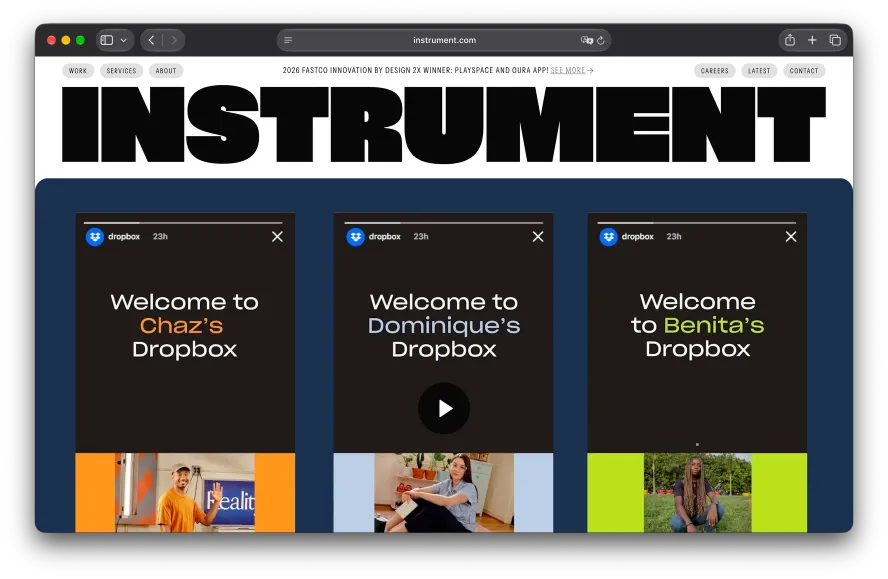
Instrument homepage in a browser window: white page with pill menu buttons Work, Services, About, Careers, Latest and Contact around an award banner, the huge black wordmark INSTRUMENT across the full width, and a navy panel below with three phone-story screens reading “Welcome to Chaz’s Dropbox”, “Welcome to Dominique’s Dropbox” and “Welcome to Benita’s Dropbox”.

Instrument’s Oura website case examines how customers learn about a complex consumer product and move toward purchase. The published work covers information architecture, content, navigation, interaction and reusable components. Research and testing informed how the product story was organized rather than being treated as a final visual layer.

This is a useful example for businesses whose website must explain unfamiliar technology. Ask how an agency would decide what visitors need to understand first, which questions belong on product pages and which require supporting content. A striking homepage does not answer those structural questions on its own.

Consider Instrument for a website that combines product education with ecommerce or a broader digital journey. Confirm the responsibility for content accuracy, photography, product data and implementation. Request examples of components and page patterns the internal team could reuse, along with the rules for introducing new content.

Relevant services evidenced here:
website strategy, UX, content structure and digital design.
Budget:
not publicly disclosed in the reviewed material.

Visit InstrumentSource: Oura website

5.Metalab

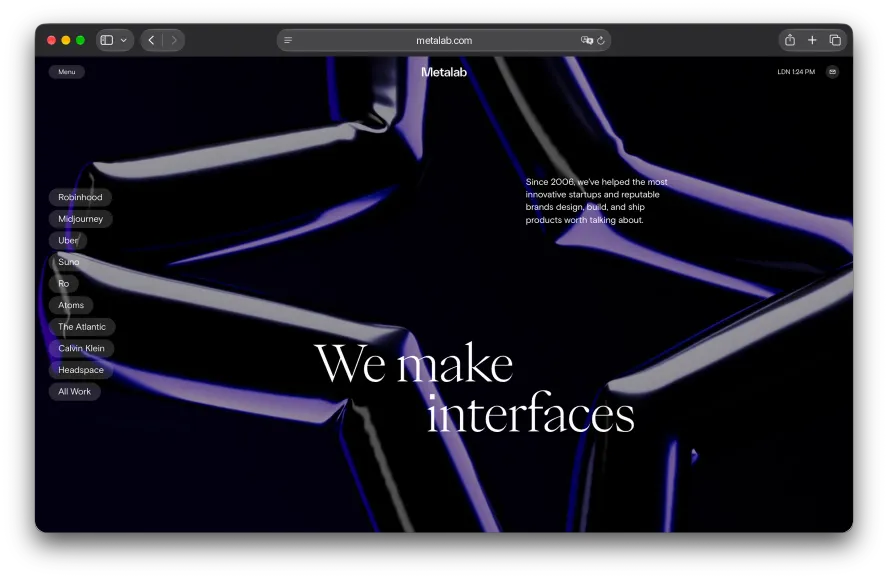
Metalab homepage in a browser window: dark page with a glossy abstract backdrop, the Metalab wordmark, a Menu button, a list of client names, a short paragraph and the headline “We make interfaces”.

Metalab’s archived Slack case documents early product design and interaction work across web and iOS, including UI, UX and a strategy concept. The agency describes working from an early prototype. This makes the example relevant to defining a usable product experience rather than simply applying a new style to a marketing site.

The case is historical. Its original market language and business figures should not be treated as current information about Slack or Metalab. A buyer should pair the example with recent portfolio work and ask which members of the proposed team have relevant experience.

Consider Metalab when a product needs clearer flows, interaction patterns and a coherent interface. Bring actual tasks, roles, data and technical constraints. Ask how the engagement will address loading, empty, error and permission states, not only the ideal path. Define whether the deliverable is a validated prototype, production-ready specifications or implemented software.

Relevant services evidenced here:
product strategy, UX/UI and interaction design.
Budget:
request a project-specific proposal.

Visit MetalabSource: Early Slack product

6.ustwo

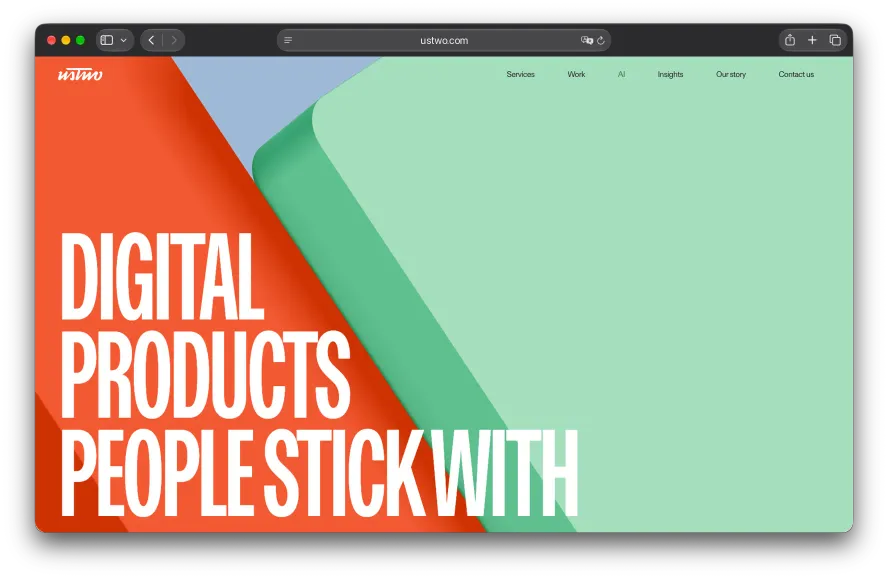
ustwo homepage in a browser window: orange and mint green page with the ustwo logo, a small menu and the headline “Digital products people stick with” in large white condensed letters.

ustwo’s Body Coach case describes turning a program previously delivered through PDFs and videos into a digital product. The experience combines workouts, meals, planning and progress. It is relevant to companies translating an existing service into an application people will return to over time.

For a comparable brief, discuss the recurring user task rather than asking for a screen-by-screen copy of the existing service. What should happen when someone misses a day, changes their goal or returns after a break? Those situations help define the product beyond its first onboarding sequence.

Consider ustwo for a consumer application whose value depends on useful, repeated interaction. Confirm research access, platform scope, engineering responsibilities and the plan for learning after launch. Published results from the Body Coach engagement do not establish a likely retention rate or outcome for another service.

Relevant services evidenced here:
digital product development and experience design.
Budget:
not publicly disclosed in the reviewed case.

Visit ustwoSource: The Body Coach

7.Hello Monday /DEPT®

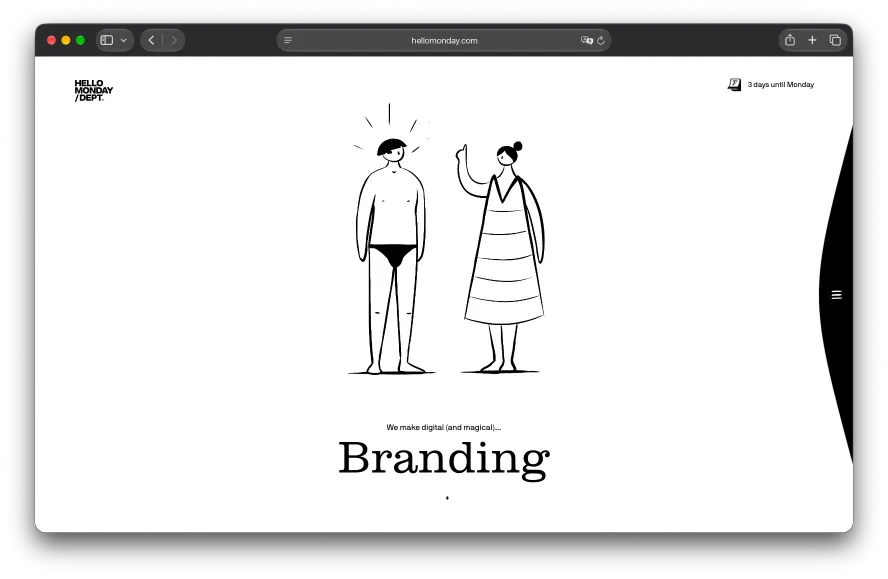
Hello Monday /DEPT® homepage in a browser window: white page with the Hello Monday /DEPT® logo at top left, a black line drawing of two standing figures, the line “We make digital (and magical)...” and the large serif word “Branding”.

Hello Monday /DEPT® documents an OPPO website project involving UX, UI, concept, research and copywriting. The case describes replacing a restrictive banner structure with a framework that could express the brand more consistently across devices and markets. That makes it relevant to businesses coordinating a large website rather than commissioning isolated pages.

The example combines a shared layout system with room for different imagery, content and product stories. Ask an agency to demonstrate both: the rules that maintain consistency and the exceptions that allow a regional or product team to communicate something specific.

Consider Hello Monday for a website framework that must balance recognizable design with varied content. Specify localization needs, component ownership, accessibility checks and approval responsibilities before comparing proposals. The case establishes the documented design contribution; it does not independently verify the current performance of OPPO’s live website.

Relevant services evidenced here:
website UX/UI, research and content-led design systems.
Budget:
request a scoped proposal.
Visit Hello Monday /DEPT®Source: OPPO

8.Stink Studios

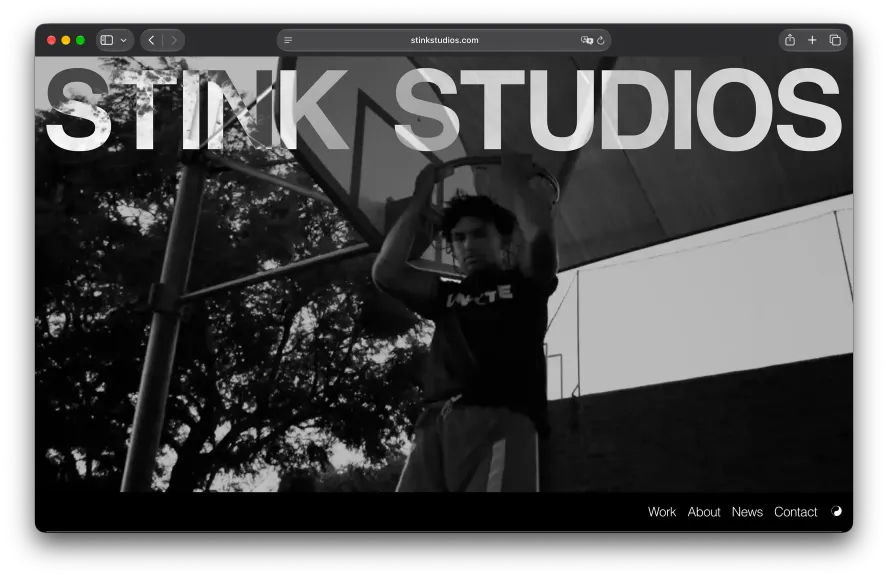
Stink Studios homepage in a browser window: the huge white wordmark STINK STUDIOS over a black-and-white video of a person hanging from a basketball hoop under trees, and a black bar at the bottom with Work, About, News and Contact links.

Stink Studios’ Spotify.Design case documents the relaunch of an editorial website for a design community. Interviews and a collaborative workshop informed the content experience, while interactions drew on Spotify’s audio context. The case is useful when a publication or content platform needs a distinctive experience that still helps visitors find material.

An editorial website introduces practical requirements that a static campaign page may not have. Ask how authors publish, how archives work, which content types share components and what happens when an external integration changes. The maintenance model belongs in the brief.

Consider Stink Studios for an interactive content destination where brand expression and information access must work together. Review how the proposed concept behaves with long titles, missing images and smaller screens. Request an explicit accessibility and performance test plan; the published case is not a current audit of the live Spotify.Design site.

Relevant services evidenced here:
digital concept, website design and build.
Budget:
not publicly disclosed in the reviewed material.

Visit Stink StudiosSource: Spotify.Design

9.Ramotion

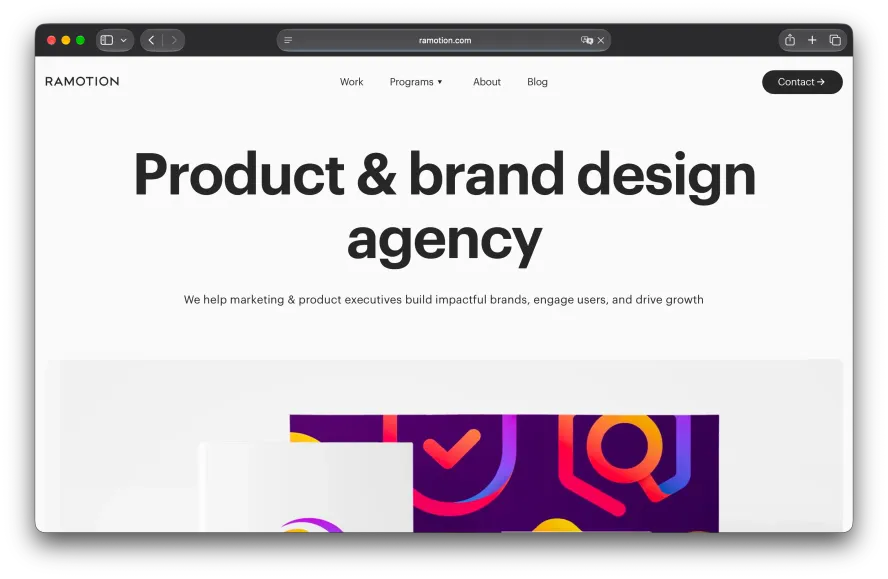
Ramotion homepage in a browser window: light page with the headline “Product & brand design agency”, a short line for marketing and product executives, a Contact button and a purple brand artwork image below.

Ramotion publishes web design and UI/UX services that connect marketing websites, digital products and interface systems. Its current service descriptions address product workflows, research, prototyping and implementation handoff. Unlike most profiles in this list, this recommendation is based on the published service scope rather than one detailed project case.

That distinction matters when you shortlist the agency. Ask for recent work close to the actual task: a marketing site is different from a workflow-heavy application, and an identity system is different from a production component library. Confirm which capability the proposed team would deliver.

Consider Ramotion when you want to discuss the relationship between a technology company’s public website and its product experience. Bring the existing design files and frontend constraints, then ask how the work would fit those systems. Require a clear boundary between design specifications, coded components and ongoing engineering support.

Relevant published services:
website design, UX/UI and design systems.
Budget:
confirm current scope and fees directly.

Visit RamotionSource: Published web and UX/UI servicesSource: Ramotion website services

10.Superside

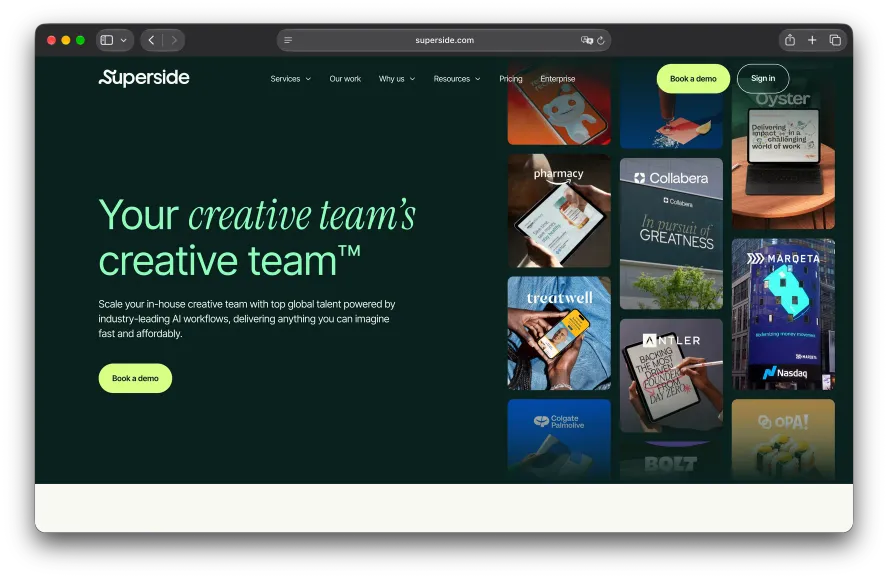
Superside homepage in a browser window: dark green page with the Superside logo, a menu of Services, Our work, Why us, Resources, Pricing and Enterprise, the mint headline “Your creative team’s creative team™”, a short paragraph, a Book a demo button and a column grid of client campaign images such as Collabera, Marqeta, Treatwell and Antler.

Superside offers subscription-based creative support and publishes guidance on scaling design systems. Its Colgate-Palmolive example concerns making reusable design resources useful across a large organization. This is a different buying model from commissioning one agency to define and build a complete application.

Consider Superside when an internal team has recurring design work, repeated formats or a system that needs broader adoption. First estimate the volume and type of requests you expect to send. Ask how work is prioritized, which specialists are available and whether the required digital deliverable includes development.

The reviewed pricing page lists subscriptions from a $15,000 monthly minimum on an annual term. Confirm software charges, capacity, rollover rules and any additional project budgets directly. A monthly budget is neither unlimited output nor a fixed price for every website request.

Relevant use case:
ongoing creative production and design-system support.
Budget:
published subscription minimum, with final commercial terms requiring confirmation.

Visit SupersideSource: Colgate-Palmolive exampleSource: Superside pricing

Which Digital Design Services Does Your Project Need?

  • A Business Website That Is Ready to Launch

    Compare Fivecube, Clay and Instrument when the immediate deliverable is a marketing website. Decide whether the brief includes positioning and copy, an existing identity, CMS setup and a production build. Ask each team to price the same page types and integrations. A homepage concept alone is not a comparable scope.

  • A Product People Use to Complete Tasks

    Compare Metalab and ustwo through the product examples above. Define the core task, user roles and supported platforms before counting screens. Include the states people encounter when data is unavailable, a request fails or they lack permission. The agency should explain how those requirements enter design and testing.

  • Connected Commerce Across Channels

    Work & Co’s IKEA case and Instrument’s Oura website offer different comparison points. The first spans a connected digital ecosystem; the second examines product education and a purchasing journey. Choose the reference that matches your actual problem, then establish integration and operational responsibilities.

  • A Reusable Website or Content Framework

    Hello Monday and Stink Studios provide examples of systems supporting varied content. Ask for templates, component rules, editorial roles and realistic content examples. If the project spans markets, test long text and localization needs before approving a framework built around short sample copy.

  • Design Support After Launch

    Superside is relevant to investigate for recurring production. A website or product agency may also offer continuing support, but that should be confirmed in the proposal. Separate new feature design, maintenance, content production and engineering so recurring fees correspond to identifiable work.

Digital Design Agency Comparisons

Fivecube vs Clay

ComparisonFivecubeClay
Reviewed examplePointExpress business websiteMarqeta marketing website
Relevant emphasisStructured UX/UI process and Webflow buildProduct storytelling, interaction and WordPress VIP
Confirm in proposalPage types, CMS, forms and handoffContent, 3D, interaction scope and maintenance

Start with the required output. Fivecube’s case is useful for a defined business website with design and implementation stages. Clay’s example is useful when the offer needs a more involved product narrative. These distinctions describe the reviewed evidence, not a ceiling on either agency’s capabilities or a comparison of universal quality.

Metalab vs ustwo

ComparisonMetalabustwo
Reviewed exampleEarly Slack interfaceThe Body Coach application
Relevant emphasisProduct flows and interaction patternsTranslating an existing service into a recurring digital experience
Confirm in proposalCurrent team, product scope and engineering handoffPlatform scope, research and post-launch learning

Metalab’s historical Slack work provides a reference for defining a product from an early prototype. ustwo’s Body Coach example provides a reference for turning an established service into an application. Ask both for recent evidence close to your audience, technical constraints and product stage before drawing a shortlist conclusion.

Instrument vs Hello Monday /DEPT®

ComparisonInstrumentHello Monday /DEPT®
Reviewed exampleOura websiteOPPO website framework
Relevant emphasisProduct education and shopping journeyConsistent brand expression across markets
Confirm in proposalContent, product data and reusable pagesLocalization, component rules and governance

Instrument’s Oura case is a useful reference when customers need to understand a complex product before purchase. Hello Monday’s OPPO case is useful when a shared website framework must support different markets and content. Both comparisons require a clear implementation brief; a design case does not automatically define the development responsibilities.

What Do Digital Design Agencies Deliver?

Digital design services can include research, information architecture, user flows, wireframes, prototypes, visual interface design and design systems. Some engagements continue into frontend development and launch. Others end with files for an internal engineering team. Specify the outputs instead of assuming every item is included.

WorkstreamUseful deliverableQuestion before approval
DiscoveryAgreed audiences, tasks and constraintsWhich decisions are supported by research?
UX structureFlows, sitemap or wireframesHave real content and failure cases been considered?
UI and prototypeResponsive screens and interaction examplesWhich states and devices are covered?
Design systemComponents, tokens and usage rulesIs this a design library, code library or both?
ImplementationWorking templates and integrationsWho owns development, testing and launch?
HandoffSource files, documentation and trainingCan the receiving team maintain and extend it?

A prototype demonstrates a proposed experience; it is not automatically a functioning product. Likewise, a Figma component does not establish that the same component exists in code. Ask the agency to show where design ends and implementation begins, especially when another supplier will build the result.

Digital Design Agency Pricing and Costs

There is no verified common rate across this selection. The cost of digital design depends on the decisions, deliverables, platforms and implementation responsibilities in the agreement. A five-page website, an ecommerce framework and a multi-role application cannot be compared through a single hourly figure without understanding their scope.

Superside provides one public reference: its reviewed pricing page lists a $15,000 monthly subscription minimum on an annual term. That describes its service model, not an average market price or a quotation for your project. Confirm the current complete terms, including software charges and additional project budgets, directly with Superside.

For a project proposal, ask for the work to be separated into discovery, UX, UI, content, development, testing and launch. Establish which items are fixed and which depend on decisions made during discovery. Include revisions, third-party assets, licensing, recruitment for research and ongoing support where relevant.

Compare the expected total and what your team must supply. A lower design fee can still leave substantial work with internal developers or content owners. When the scope is uncertain, consider a defined discovery engagement with a useful deliverable and a decision point before the larger commitment.

How to Choose a Digital Design Agency

Write the problem in terms of what someone needs to do. For example, a customer may struggle to compare subscription plans, a dispatcher may miss a critical status, or a new visitor may not understand the offer. Those are different briefs even if each ends with new interface screens.

Review two or three relevant examples and ask what the agency actually owned. Separate strategy, design, content, implementation and work completed by partners. A client logo does not answer those questions. Historical cases can demonstrate a contribution, but they should be discussed alongside current capabilities and the proposed working team.

Meet the people expected to deliver the work. Establish who makes design decisions, how feedback is gathered and which decisions belong to your team. Set approval milestones around the structure and core flows before extensive visual production. Late changes become easier to discuss when the process is explicit.

Finally, define acceptance and handoff. Agree on responsive behavior, interaction states, accessibility checks, documentation and source ownership. If development is included, identify the launch environment and who resolves defects. If it is excluded, ensure your engineers can review the design before it is called complete.

How We Selected and Compared These Agencies

This editorial selection uses official agency service pages and published project accounts checked on 28 October 2026. We included providers with evidence relevant to websites, applications, interaction or repeatable digital delivery. Ramotion is described through its current service offering; the other entries identify specific examples.

Recommendations interpret the documented contribution and practical project fit. The order is not a numerical customer-review score. We have not commissioned a common test project, verified every reported commercial outcome or established current availability. No star ratings or aggregate scores are assigned.

The cases cover different periods. Metalab’s Slack work is explicitly historical, and examples from other agencies do not imply that those client relationships are current. Prices reflect the reviewed source, require confirmation and should not be transferred to a different scope.

Read about our editorial approach

Frequently Asked Questions

What Is Digital Design?

Digital design creates visual and interactive experiences for screens. Depending on the project, it includes websites, applications, interface systems and digital content. A service proposal should identify the specific outputs and whether research, content, development and testing are included.

How Is Digital Design Different from Graphic Design?

Graphic design is a visual communication discipline used across print and digital formats. Digital design can add responsive layouts, interaction, interface states and product workflows. The distinction matters when the work needs to function as a website or application rather than exist as a static asset.

Can One Agency Design and Build the Website?

Yes. Fivecube’s PointExpress case and Clay’s Marqeta case document both design and implementation. Confirm the platform, CMS, integrations, testing and launch responsibilities. An agency offering website design does not necessarily include those activities in every proposal.

Which Agencies Should a SaaS Team Compare?

Start with the work you need: Fivecube for a business website brief, Clay for product explanation and Metalab for product interface design. Ramotion publishes relevant website and UI/UX services. Request recent SaaS evidence and a clear scope instead of treating this shortlist as proof that every provider fits every product.

How Much Do Digital Design Services Cost?

Pricing depends on scope, delivery model and implementation. This guide does not establish a market average. One public example is Superside’s $15,000 monthly subscription minimum on an annual term. Obtain a current complete proposal before comparing that model with a fixed project.

What Files Should the Agency Hand Over?

Agree on editable source files, component libraries, responsive specifications, interaction notes, asset licenses and implementation documentation. Where code is included, specify repository access and ownership. Include a handoff session with the people who will maintain the work rather than accepting a folder without explanation.

Sources and Updates

The links beside each profile identify the official material supporting its inclusion. Published case studies describe the agency’s account of its contribution. Service labels, prices and availability can change. Send the affected passage and a supporting public source when requesting a correction.

Use this guide to the best digital design agencies as a starting point for a scoped conversation. Compare the proposed team and deliverables with your actual task before selecting a partner.

Submit a correction or suggest an agency